
Criminal Cases in the Coffee County Courts
Coffee County sits in Tennessee's Fourteenth Judicial District. The Coffee County Circuit Court is the felony trial court and operates in two divisions. Part I is assigned to Judge William A. Lockhart, while Part II is assigned to Judge Robert T. Carter. A felony case commonly reaches Circuit Court only after its early General Sessions stage and grand-jury action. The Circuit file then tracks arraignment, motions, a plea or trial, the judgment, and the sentence.
Coffee County General Sessions also has two divisions. It hears felony preliminary matters and may try misdemeanors when the accused waives grand-jury investigation and a jury trial. Part I meets on Tuesday. Part II meets Monday and Thursday, with trials and preliminary hearings generally set in the afternoon. Jenny Anthony's Circuit Court Clerk office maintains Circuit, General Sessions, and Juvenile dockets and finances. The clerk, not the arresting agency, is the custodian for the filed Coffee County criminal case.
The official Circuit Court page shows the two local divisions and their assigned judges.
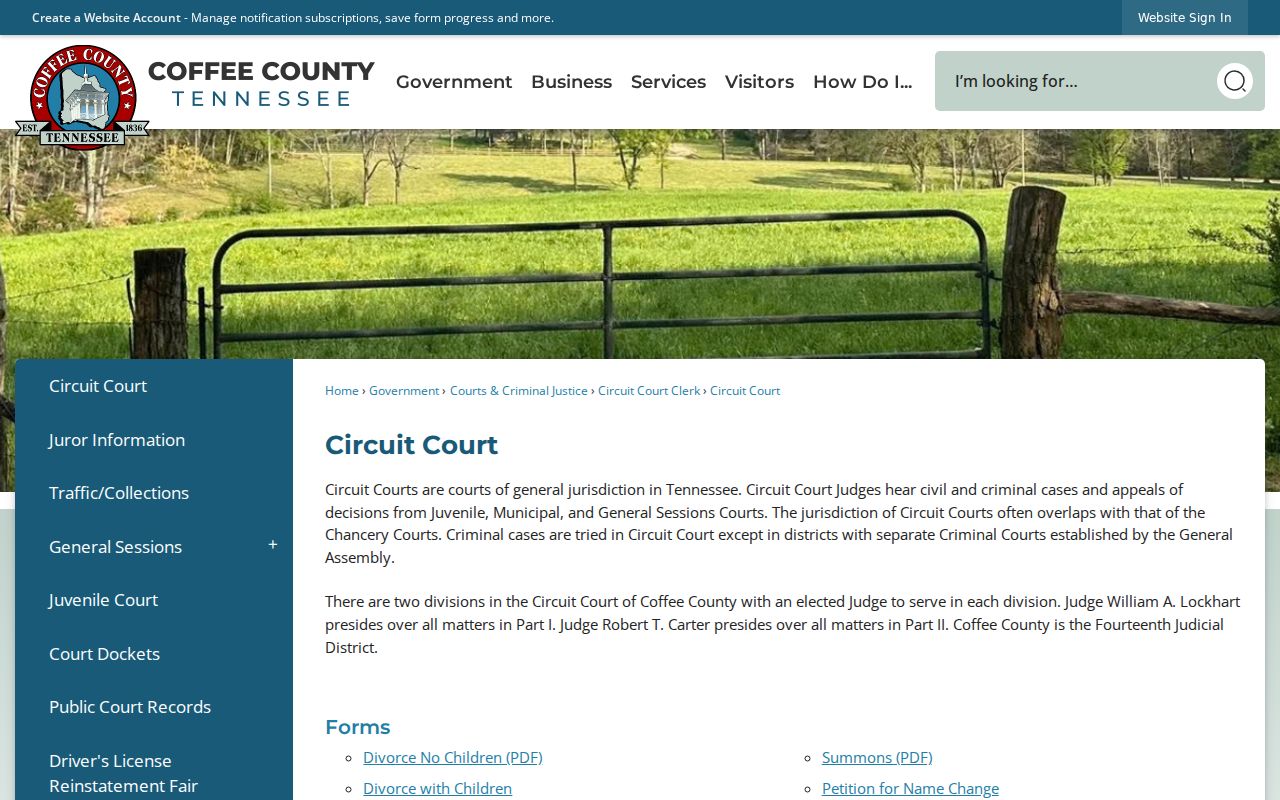
That division structure helps a reader match a docket heading to the correct Coffee County courtroom and judge.
Search Coffee County Criminal Docket PDFs
Coffee County does not provide a comprehensive free trial-court name database. Instead, its Court Dockets page works as a shelf of dated PDF documents. Choose General Sessions Criminal or Circuit Criminal first. Then open the document whose date and proceeding type fit the case. General Sessions listings may be labeled Arraignment, Prelim, Status, Special Set, Additional, or Add On. A browser or PDF reader's find command can locate an exact or partial name within an opened file.
Check more than the first PDF for a date. Coffee County can post several lists for one court day, and an add-on docket may contain a matter absent from the earlier list. A name on a docket means the case was scheduled. It does not show that the hearing occurred, that the printed charge remained unchanged, or that the person was convicted. A missing name can reflect another date, division, spelling, restricted status, filing delay, or a later calendar change.
| Control | Type | Required | Use |
|---|---|---|---|
| General Sessions Criminal | Section and links | No | Dated arraignment, preliminary, status, additional, add-on, and special-set PDFs |
| Circuit Criminal | Section and links | No | Dated Circuit criminal, preliminary, and arraignment PDFs |
| PDF find | Reader text search | No | Exact or partial name after the file opens |
The official docket shelf shows how Coffee County groups these current court documents.
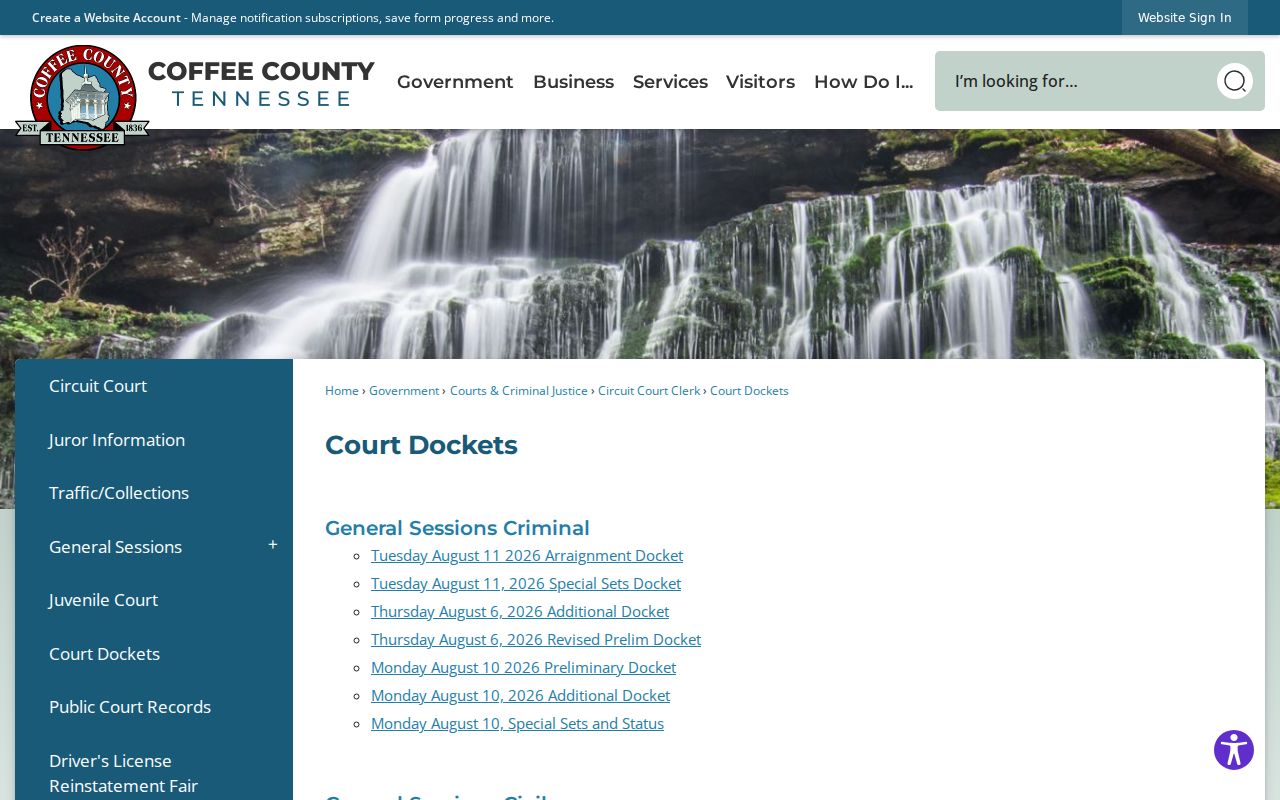
The image reinforces the key limit: Coffee County publishes dated files, not a full case-history search engine.
How to Search Case Records
Start online for a scheduling lead, but finish with the Coffee County clerk when the outcome matters. A narrow request is easier to identify than a request for a person's entire criminal record. Gather the spelling used during the case, the approximate arrest or filing date, charge, arresting agency, and any case, citation, or warrant number. Ask for distinct documents because a docket sheet, charging instrument, judgment, and sentence order answer different questions.
- Open the county docket page and choose General Sessions Criminal or Circuit Criminal based on the known stage.
- Select the dated arraignment, preliminary, status, add-on, special-set, or Circuit criminal PDF that fits the matter.
- Use document find with an exact or partial name, then note the court, division, date, and case number.
- Call the clerk at 931-723-5110 to confirm the file, ask about older records, and learn current copy or certification options.
- Request the docket sheet, charging paper, final judgment, and sentence order by name rather than asking only for a criminal record.
No current Coffee County criminal-copy fee schedule was located in the official sources. Ask the clerk for an estimate before ordering a large set. The county's online Collections channel concerns court debt and payments. It is not a case-document purchase portal.
Coffee County Criminal Clerk Counter
The Circuit Court Clerk is at the Coffee County Justice Center, 300 Hillsboro Boulevard, Manchester, Tennessee 37355. Counter hours are Monday through Friday, 8:00 a.m. to 4:30 p.m. Call 931-723-5110, fax 931-723-5116, or mail a request to P.O. Box 629, Manchester, TN 37349. The office can help locate a known public file, explain the copy process, and provide certified records. Staff cannot give legal advice.
Circuit Court Clerk
300 Hillsboro Boulevard
Manchester, TN 37355
931-723-5110
Monday-Friday, 8:00 a.m.-4:30 p.m.
Coffee County visitors pass a security checkpoint. Coffee County identifies overflow parking in the gravel lot on Madison Street across from the Justice Center. Disability assistance routes through clerk and ADA coordinator Jenny Anthony at the main clerk number or jennya@coffeecountytn.org. Those details are worth confirming before a trip for an older or certified Coffee County criminal case file.
The official clerk page presents the office location, hours, and contact routes.
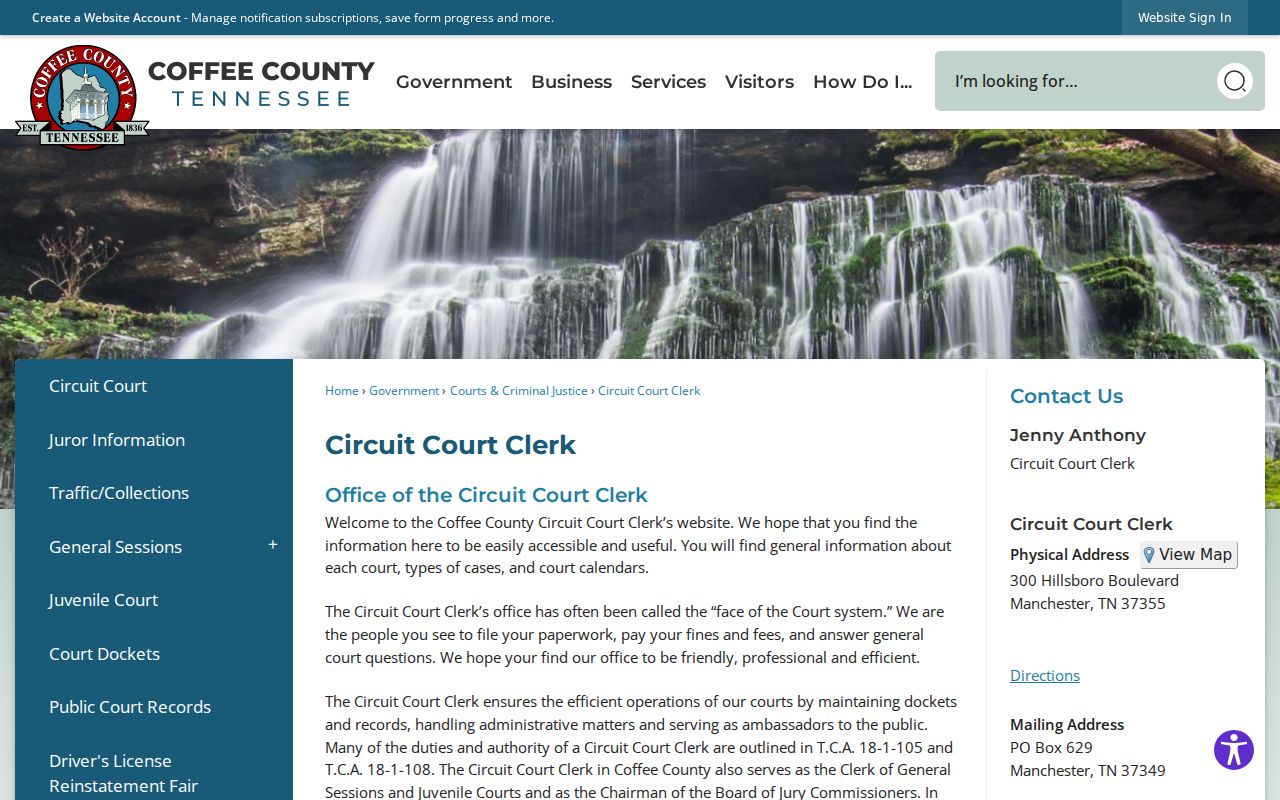
This office is the direct fallback when a docket PDF is too new, too old, or too limited to answer the question.
What the Case File Shows
A Coffee County court file records the prosecution, not merely the arrest. Its most useful parts identify what the state filed, how the case moved, and how the judge resolved each count. The filed charge can differ from the booking charge. An indictment may also replace an earlier complaint. Read the final judgment beside the charging paper instead of assuming the first allegation stayed intact.
| Case Number & Court | The local identifier, division, and venue handling that stage |
|---|---|
| Charging Document | Complaint, warrant, citation, indictment, or information stating the filed accusation |
| Docket Entries | A chronological register of filings, settings, orders, and case activity |
| Hearing Dates | Scheduled arraignment, preliminary, status, motion, plea, or trial events |
| Disposition & Judgment | The outcome for each count, such as plea, conviction, dismissal, acquittal, or nolle prosequi |
| Sentence & Conditions | The court-ordered term, probation, costs, restitution, and other recorded conditions |
A Coffee County docket PDF offers only a schedule snapshot and a shorter field set: court, division, date, judge, docket type, sequence, case number, accused party, charge description, and agency. Counsel or status is not always shown. For a settled outcome, obtain the judgment or disposition from the clerk.
Coffee County Criminal Sessions Calendar
The General Sessions criminal page explains the court's local role and weekly pattern. Judge Greg Perry serves Part I, and Judge Gerald Ewell Jr. serves Part II. Part I's Tuesday setting and Part II's Monday and Thursday settings help explain why multiple dated documents appear during a week. Trials and preliminary hearings are generally afternoon matters.
Coffee County docket labels carry procedural meaning. An arraignment is the formal charge and plea stage. A preliminary hearing tests whether a felony allegation has enough support to proceed. A status setting checks progress. Special Set points to a designated hearing, while Additional and Add On signal later calendar entries. None of these labels supplies the final Coffee County case outcome on its own.
The official criminal-calendar page provides the source view for jurisdiction and session days.
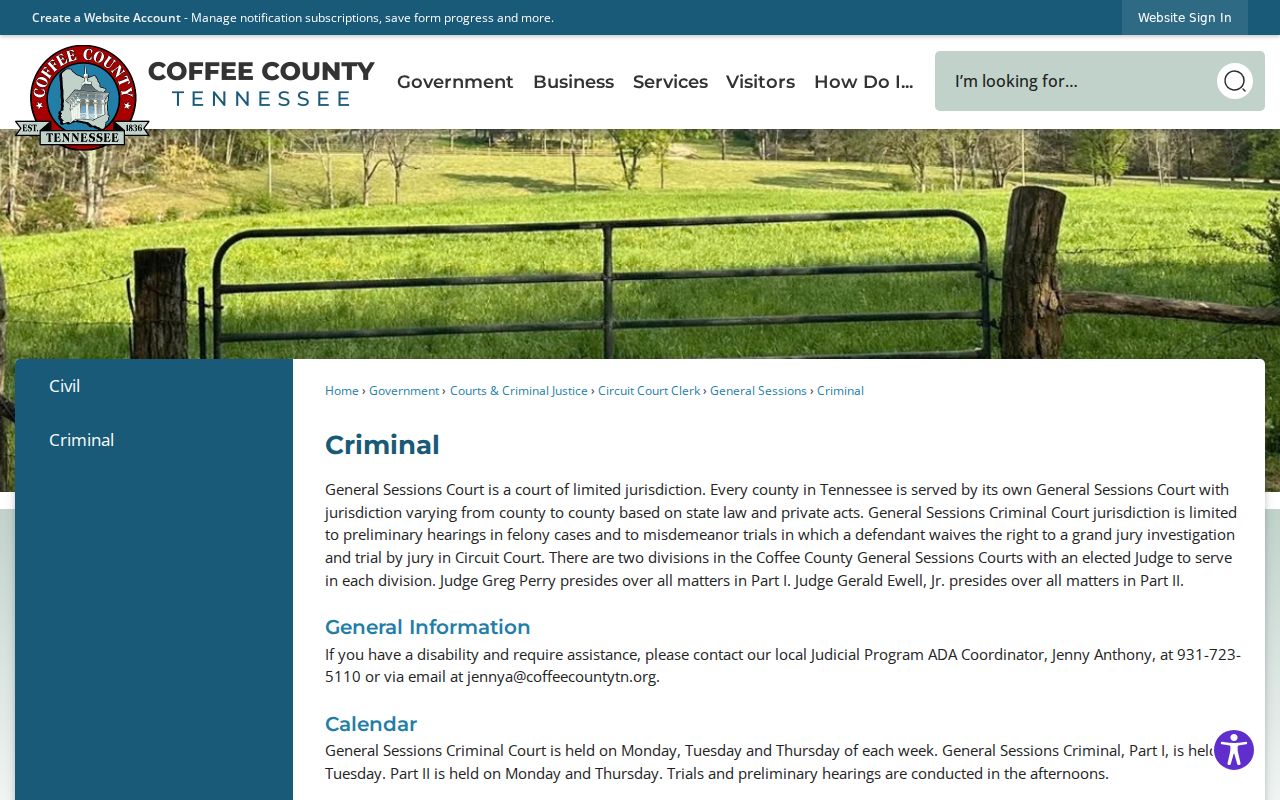
The local schedule clarifies which division may appear on a posted docket and when early felony proceedings tend to occur.
Stages of a Criminal Case
A Coffee County case can begin with a complaint, warrant, or citation. Custodial cases may also have arrest and booking records, but those remain separate from the court file. General Sessions addresses the first court stages, bond issues, misdemeanor matters within its authority, and felony probable-cause proceedings. A felony that continues moves through grand-jury action and into one of the two Circuit divisions.
Case flow: Charges Filed › Arraignment › Pretrial › Plea or Trial › Disposition › Sentencing
Motions, plea talks, or added counts in Coffee County can change the path. After judgment, an appeal creates a different record layer. The Tennessee appellate opinion search covers published appellate opinions, not every local trial docket or filing. Use the Coffee County clerk for the trial file and the appellate system only when the matter actually reached that level.
Coffee County Dockets Are Not Judgments
Coffee County warns that Circuit dockets have not been automatically continued since July 1, 2022. An old printed date should not be treated as though it silently carried forward. Confirm the current setting with the clerk. This local notice matters most when a person finds an older PDF and assumes it still states the next event.
Disposition terms require equal care. Dismissal ends a charge without conviction. Nolle prosequi means the prosecution declined to proceed at that point. Acquittal is a not-guilty result. A guilty plea or trial conviction produces an adjudication of guilt. Judicial diversion is a qualified deferred route under Tennessee law, not the same label as a conviction or a simple dismissal. The complete Coffee County judgment controls.
- Docket
- The court's schedule and chronological event record.
- Disposition
- The recorded outcome of a charge or case.
- Indictment
- A grand-jury charging instrument used as a felony proceeds.
- Nolle prosequi
- A recorded decision by the prosecution not to continue a charge.
Note: Compare every charged count with its own final disposition because one Coffee County case may end in several different results.
Coffee County Felony Court Path
A felony allegation often appears first in a General Sessions preliminary setting. That does not turn General Sessions into the felony trial court. If the matter proceeds through the grand jury, the Circuit Court file becomes the source for later arraignment, motions, plea or trial, judgment, and sentence. Case headings, numbers, and charge language can shift between stages, so keep both the early docket clue and the later Circuit identifier.
This division of work also explains why an arrest report cannot answer the final case question. The sheriff or police department keeps its own event narrative. The jail keeps the booking event. The clerk keeps the prosecution. For more detail on that earlier custody layer, the county's arrest-history record routes distinguish agency reports from the court outcome.
Access & Restrictions
The Tennessee Public Records Act generally opens official records to Tennessee citizens unless another law makes the material confidential. The access rule in T.C.A. §10-7-503 works with statutory exceptions. Juvenile records, expunged matters, protected victim details, personal identifiers, and some active-investigation material may be withheld, absent, or redacted. A blank online result does not prove that no event or restricted file exists.
When a public Coffee County case does not appear online, call or visit the clerk with a narrow set of identifiers. If an arrest appears in the Tennessee Bureau of Investigation repository without a matching outcome, obtain the certified local judgment first. Dispositions can fail to link to an arrest cycle when key information is missing. The Coffee County file remains the best evidence of what the local court decided.